Once upon a time, there was a little girl named Nikki, who loved to look at things. She had a magnifying glass that she used to see tiny details of flowers, insects, and coins. She also had a pair of binoculars that she used to see faraway things like birds, stars, and mountains.
One day, she found a strange box in her attic. It had a label that said “Lenses”. She opened the box and saw many different shapes of glass inside. Some were thick in the middle and thin at the edges, like her magnifying glass. Some were thin in the middle and thick at the edges, like the bottom of a bottle. Some were curved on both sides, like a ball cut in half. Some were flat on one side and curved on the other, like a spoon.
She wondered what they were for and how they worked. She took them out of the box and started to play with them. She held them up to her eyes and looked at different things around her. She noticed that some lenses made things look bigger and closer, while others made things look smaller and farther away. She also noticed that some lenses made things look clear and sharp, while others made things look blurry and distorted. She decided to name them according to how they looked and what they did.
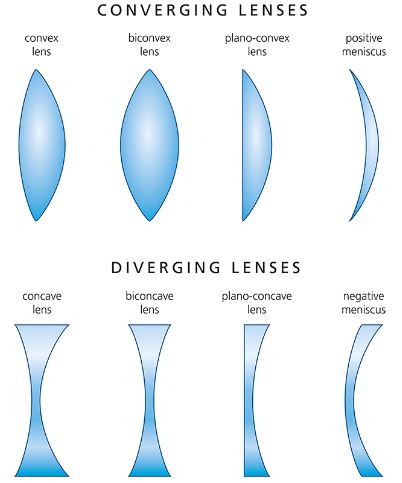
She called the lenses that were thick in the middle and thin at the edges “convex lenses”, because they made things look bigger and closer.
She called the lenses that were thin in the middle and thick at the edges “concave lenses”, because they made things look smaller and farther away.
She learned that convex lenses are also called “converging lenses”, because they bend light rays inward and make them meet at a point called the “focal point”.
She learned that concave lenses are also called “diverging lenses”, because they bend light rays outward and make them spread apart from a point called the “focal point”.
She also learned that there are different types of convex and concave lenses based on how curved they are on both sides. For example, a lens that is curved on both sides equally is called a “biconvex lens” or a “biconcave lens”, depending on whether it is convex or concave.
A lens that is flat on one side and curved on the other is called a “plano-convex lens” or a “plano-concave lens”, depending on whether it is convex or concave.
She had fun experimenting with different combinations of lenses and seeing how they changed the way things looked.
She realized that lenses are used in many devices that help people see better or differently, such as glasses, cameras, telescopes, microscopes, and projectors.
She was amazed by how much she could learn from playing with lenses. She decided to keep the box of lenses and use them to explore more of the world around her.

 Short stories for kids