Yesterday, Nikki had understood the concept of Inertia.
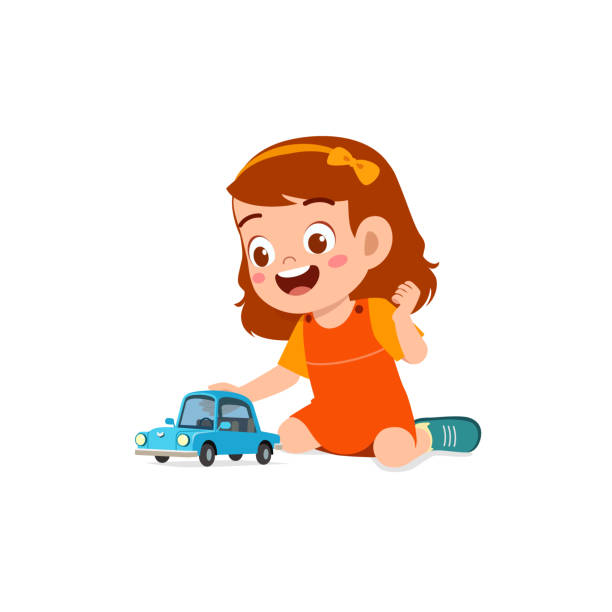
Next day, when she was playing with her toy car, she noticed that when she pushed it hard, it went really far. But when she pushed it gently, it didn’t go very far at all.
Nikki’s father saw her playing and he explained to her that when she pushed the car hard, it had something called momentum.
Momentum is like a magic power that makes things keep moving when they’re already moving. It’s like when you’re on a swing and you keep going back and forth even when you stop pushing.
The father told Nikki that momentum is made up of two things: mass and speed. Mass is how heavy something is, and speed is how fast it’s going. So when Nikki pushed the car hard, it had more momentum because it was heavier and going faster.
Nikki thought this was really cool! She started pushing her car harder and harder to see how far she could make it go. And every time she did, she felt like she had a little bit of magic power too.
Once upon a time, there was a little girl named Nikki. She loved playing with her toys and running around in the park.
One day, she was playing with her toy car when she suddenly stopped it. She noticed that the car didn’t want to move anymore. She tried pushing it but it was hard to make it move again. She asked her father to explain why was it happening.
Nikki’s father explained to her that the car didn’t want to move because of something called “inertia”.
Inertia is when an object doesn’t want to change its motion. So if an object is moving, it wants to keep moving. And if an object is still, it wants to stay still.
Nikki’s father told her that this is why it’s important to wear seat belts in the car. When the car stops suddenly, our bodies want to keep moving forward because of inertia. But the seat belt helps us stay in place and not get hurt.
Nikki was happy to learn the concept of inertia. She also promised her father that she will always fasten her seat belt while travelling in any vehicle.
Once upon a time, there was a little girl named Nikki. She was watching News on the TV. She heard the term “Global warming” many times in the said News programme. She wanted to know more about global warming. When her father returned from office, she asked her about global warming.
Her father explained this through a story as follows:
“Once upon a time, there was a beautiful planet called Earth. It was home to many creatures like you and me. The sun would shine on the planet and make it warm and cozy.
But one day, people started using too much energy and burning too many things like coal, oil, and gas. This made the planet too hot and it started to change. The ice in the North Pole started melting and the sea level started rising. This is called global warming.
It’s like when you wear too many clothes on a hot day and you start feeling very hot and uncomfortable. We need to take care of our planet so that it stays beautiful for all of us to live on.”
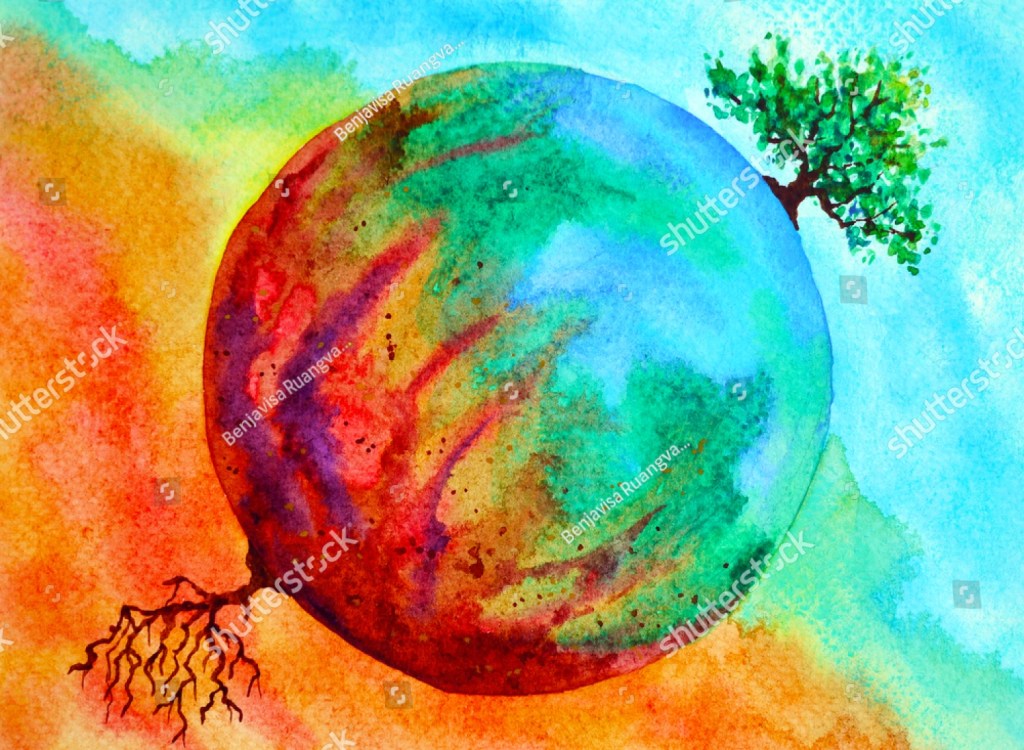
Global warming
Nikki understood the concept of global warming and promised to do her bit to reduce global warming.
Once upon a time, there was a little girl named Nikki. She was travelling by train. On one of the stations, she saw a Goods train carrying some black stones. Her father informed her that those are Coal.
Nikki was inquisitive about Coal, its origin and usage.
Her father told her a small story to explain about Coal, which is as follows:
” Once upon a time, there was a big forest full of trees and plants. They were very happy and enjoyed the sunlight and the rain. They grew tall and strong, and made friends with the animals that lived in the forest.
One day, a big storm came and knocked down many trees and plants. They were very sad and scared. They could not stand up again or get any sunlight or rain. They lay on the ground and slowly turned brown and dry.
Some of the trees and plants were buried under the soil by the wind and the water. They felt very cold and dark. They missed their friends and the sun. They wished they could go back to the forest.
But they could not go back. They stayed under the ground for a very long time. Millions of years passed by. The earth changed a lot. It became hotter and heavier. The trees and plants under the ground were squeezed and cooked by the heat and the pressure.
They changed too. They became hard and black. They were no longer trees or plants. They became something else. Something that could burn and make heat and light. They became coal.
One day, some people came and dug up the coal from the ground. They took it to their homes and factories. They used it to make fire and electricity. They used it to cook food and warm their houses.
The coal was happy to be useful again. It remembered its old life in the forest, but it also liked its new life with the people. It felt proud to give them energy and comfort. “
Coal formation
Nikki was amazed to know about Coal and its origin.
Once upon a time, there was a little girl named Nikki who loved balloons. She liked to play with them and watch them float in the air. She wondered why they could fly so high, while she had to stay on the ground.
One day, she asked her father, “Papa, why do balloons float?”
Her father smiled and said, “Balloons float because they are filled with a gas that is lighter than air. Air is made of tiny particles that have weight. The gas inside the balloon has less weight than the same amount of air outside the balloon. So the balloon pushes the air down and the air pushes the balloon up. That’s why it floats.”
Nikki thought for a moment and said, “But Papa, what if I fill the balloon with water? Will it still float?”
Her father said, “No, it won’t. Water is heavier than air, so the balloon will sink. Do you want to try it?” Nikki nodded eagerly and ran to the kitchen.
Nikki filled a balloon with water from the tap and tied a knot. Then she let go of the balloon and watched it fall to the floor with a splash.
She said, “Wow, Papa, you were right! The water balloon is heavy and it doesn’t float.” Her father said, “Yes, dear. And do you know what else floats and sinks?” Nikki shook her head and said, “No, what else?”
Her father said, “Well, anything that is lighter than water will float on water, and anything that is heavier than water will sink in water. For example, a cork floats on water because it has less weight than the same amount of water. A stone sinks in water because it has more weight than the same amount of water.” Nikki said, “Oh, I see. So floating and sinking depend on how heavy something is compared to what it is in.” Her father said, “Exactly. And that’s called buoyancy.Buoyancy is the force that makes things float or sink in a fluid like air or water.”
Nikki said, “Buoyancy. That’s a big word. But I think I understand it now. Thank you, Papa.”
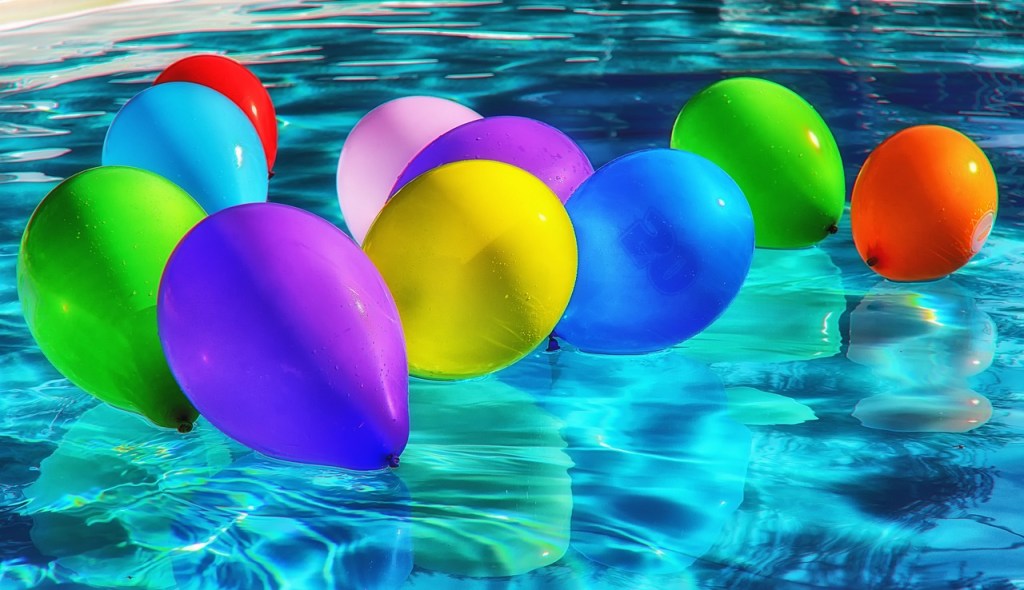
Air filled Balloons floating in water
Her father hugged her and said, “You’re welcome, my smart girl. Now let’s go outside and play with some balloons. “
Once upon a time there was a little girl named Nikki, who was a curious and adventurous girl who loved to explore the world around her. While learning about gravity, she was very fascinated by the story of “Newton and falling apple”.
Do you remember…she had got an amazing time machine? In order to meet Newton, the Scientist, Nikki went back in time using her time machine. She met Newton and found him very smart and who knew a lot about how things move and why. He agreed to teach Nikki some interesting facts and rules about motion that he called his laws.
One day, Nikki and Newton decided to go to the park and play with some toys. They brought a ball, a skateboard, a kite and a rocket. They had a lot of fun trying different things with their toys and learning from Newton.
The first thing they did was to roll the ball on the ground. Nikki gave the ball a gentle push and watched it roll away. Newton asked, “Do you know why the ball keeps moving after you push it?” Nikki shook her head. Newton explained, “That’s because of my first law of motion. It says that an object at rest stays at rest, and an object in motion stays in motion, unless acted upon by an unbalanced force.”
Nikki thought for a moment and asked, “What is an unbalanced force?” Newton said, “An unbalanced force is something that changes the speed or direction of an object. For example, when you push the ball, you are applying an unbalanced force that makes it move faster. But when the ball rolls on the ground, it slows down because of another unbalanced force called friction. Friction is a force that opposes the motion of an object. It happens when two surfaces rub against each other, like the ball and the ground.”
Nikki nodded and said, “Yes I remember that if there was no friction, the ball would keep rolling forever.” Newton said, “Yes, that’s right. In fact, in outer space, where there is no air or friction, objects can keep moving forever unless they hit something or are pulled by gravity.” Nikki said, “Wow, that’s amazing!”
The next thing they did was to ride the skateboard. Nikki stood on the skateboard and pushed herself forward with one foot. She felt the wind in her hair and enjoyed the speed. Newton said, “Do you know why you can move faster or slower on the skateboard?” Nikki said, “I guess it depends on how hard I push myself.” Newton said, “That’s correct. And that’s because of my second law of motion. It says that the acceleration of an object is proportional to the net force acting on it and inversely proportional to its mass.”
Nikki frowned and said, “That sounds complicated.” Newton said, “Don’t worry, it’s not as hard as it sounds. Acceleration means how quickly an object changes its speed or direction. Net force means the total amount of force acting on an object from all directions. Mass means how much matter an object has or how heavy it is. So what my second law means is that if you want to make something move faster or slower, you have to apply more or less force to it. And if something is heavier or lighter, it will be harder or easier to make it move faster or slower.”
Nikki said, “Oh, I get it now. So if I want to go faster on the skateboard, I have to push harder with my foot. And if I want to stop, I have to apply a force in the opposite direction, like dragging my foot on the ground.” Newton said, “Exactly. And if you were riding a bicycle instead of a skateboard, it would be easier to go faster because a bicycle has less mass than a skateboard.” Nikki said, “That makes sense.”
The last thing they did was to fly the kite and launch the rocket. Nia held the kite string and ran with the wind until the kite lifted off the ground and soared high in the sky. She felt a tug on the string as the kite pulled her along. Newton said, “Do you know why the kite flies?” Nikki said, “I think it’s because of the wind.” Newton said, “That’s partly true. The wind provides an upward force that lifts the kite up. But there is also another force that keeps the kite from flying away. Can you guess what it is?” Nikki looked at the string and said, “Is it the tension in the string?”
Newton said, “Yes, that’s right. The tension in the string provides a downward force that balances out the upward force from the wind. This creates a stable equilibrium where the kite stays at a constant height.”
Nikki said, “I see. So if I let go of the string, the kite will fly away?” Newton said, “Yes, it will. And if you pull on the string too hard, the kite will come down.” Nikki said, “I understand.”
Then they switched to the rocket. Nikki pressed a button and watched the rocket shoot up into the air with a loud whoosh. She saw a trail of smoke and fire coming out of the rocket’s tail. Newton said, “Do you know why the rocket flies?” Nikki said, “I think it’s because of the fire.” Newton said, “That’s partly true. The fire provides a thrust force that pushes the rocket up. But there is also another force that pushes the rocket down. Can you guess what it is?” Nikki said, “Is it gravity?” Newton said, “Yes, that’s right. Gravity is a force that attracts every object to the center of the earth. It pulls everything down, including the rocket. So the rocket has to overcome gravity to fly up.”
Nikki said, “I see. So if the rocket runs out of fuel, it will fall down?” Newton said, “Yes, it will. And if the rocket has more fuel, it will fly higher.” Nia said, “I understand.”
Newton smiled and said, “You’re very smart, Nikki. You’ve learned a lot today. Do you know what else you’ve learned?” Nikki said, “What?” Newton said, “You’ve learned my third law of motion. It says that for every action, there is an equal and opposite reaction.”
Nikki thought for a moment and said, “Is that like when I push the ball, the ball pushes me back?” Newton said, “Yes, that’s exactly right. When you apply a force to an object, the object applies an equal and opposite force to you. That’s why you feel a recoil when you launch the rocket or a tug when you fly the kite. The forces are always balanced in pairs.”
Nikki said, “Oh, I get it now. That’s very cool.” Newton said, “I’m glad you think so. You’ve just learned the basics of physics, which is the science of motion and forces. There are many more things to discover and explore in this wonderful world of ours.” Nikki said, “Thank you for teaching me, Newton. You’re the best friend ever.” Newton said, “You’re very welcome, Nikki. And thank you for being my friend too.”
They hugged each other and promised to meet once in a while, whenever Nikki needed to learn more about Science. Thereafter, Nikki returned back to her time using the time machine.
Nikki was feeling very proud of meeting Newton in person and learning “Laws of Motion ” directly from Newton.
Once upon a time, there was a little girl named Nikki who loved to play with her toys. She had a lot of different toys, but her favorite ones were her magnets. Magnets were special toys that could stick to each other and to some other things, like the fridge or the metal box. Nikki liked to make different shapes and patterns with her magnets, and sometimes she would pretend they were talking to each other.
One day, Nikki decided to take her magnets outside and play with them in the garden. She found a nice spot under a big tree and started to arrange her magnets on the grass. She made a circle of red magnets, a square of blue magnets, and a triangle of green magnets. She was very happy with her creation.
But then, something strange happened. The red magnets started to move by themselves, and they left the circle. They moved towards the blue magnets and stuck to them. The blue magnets also moved by themselves, and they left the square. They moved towards the green magnets and stuck to them. The green magnets also moved by themselves, and they left the triangle. They moved towards the red magnets and stuck to them.
Nikki was very surprised and confused. She wondered why her magnets were behaving so weirdly. She picked up one of the red magnets and tried to pull it away from the blue magnet, but it was very hard. She felt a force that was pulling them together. She tried to push them apart, but it was also very hard. She felt another force that was pushing them away.
She did the same thing with the other magnets, and she noticed that some of them were attracted to each other, while some of them were repelled by each other. She also noticed that some of them had a letter N on one side, and a letter S on the other side.
She thought for a while, and then she had an idea. She remembered that her father had once told her about something called magnetism . Magnetism was a kind of invisible power that made some things stick together or push apart. Magnets had two ends called poles, one north and one south. Opposite poles attracted each other, while same poles repelled each other.
She realized that her magnets were following this rule of magnetism. The red magnets had N on one side and S on the other side. The blue magnets had S on one side and N on the other side. The green magnets had N on both sides. That’s why the red and blue magnets stuck together, because their opposite poles matched. And that’s why the green magnets pushed away from each other, because their same poles clashed.
Nikki felt very smart and proud of herself for figuring out this mystery. She decided to experiment more with her magnets and see what else they could do. She learned that she could make different shapes by changing the positions of the poles. She learned that she could make her magnets stick to some things like nails or coins, but not to others like wood or plastic. She learned that she could make her magnets move without touching them by using another magnet.
She had so much fun playing with her magnets and learning about magnetism. She thanked her father for teaching her this amazing concept, and also for buying her these wonderful toys.
Once upon a time, there was a little girl named Nikki who loved to play with water. She liked to splash it in the bathtub, pour it into different containers, and watch it drip from the faucet. She was curious about water and wanted to know more about it.
One day, she asked her father, “Papa, what is water made of?” Her father smiled and said, “Water is made of tiny, tiny things called molecules. They are so small that you can’t see them with your eyes, but they are always moving and changing.”
“Really? How do they change?” Nikki asked.
“Well, they change depending on how much heat they have. Heat is like energy that makes things warm or hot. When water has a lot of heat, it becomes steam. Steam is water in the form of gas. Gas is like air that you can’t see or touch, but you can feel it when it blows on your face.”
“Wow, that’s cool! And what happens when water has less heat?” Nikki asked.
“When water has less heat, it becomes liquid. Liquid is water in the form of drops that you can see and touch. Liquid can flow and take the shape of any container. You play with liquid water every day.”
“I see. And what happens when water has even less heat?” Nikki asked.
“When water has even less heat, it becomes ice. Ice is water in the form of solid. Solid is water in the form of hard and cold shapes that you can hold and break. Solid can’t flow or change its shape unless you melt it or cut it.”
“Wow, that’s amazing! So water can be gas, liquid, or solid depending on how much heat it has?” Nikki asked.
“That’s right. And those are the three states of matter: gas, liquid, and solid. Matter is anything that takes up space and has mass. Water is one kind of matter, but there are many others. For example, air is matter in the form of gas, milk is matter in the form of liquid, and chocolate is matter in the form of solid.”
“I get it now! Thank you, Papa!” Nikki said.
“You’re welcome, sweetie. I’m glad you learned something new today.” Her father said.
And they hugged and went to have some ice cream together.
Once upon a time, there was a little girl named Nikki who loved to play with her toys. She had a lot of toys, but her favorite ones were her flashlight and her magnifying glass. She liked to use them to explore the world around her. One day, she decided to go on an adventure in her backyard. She took her flashlight and her magnifying glass with her and started looking for interesting things.
She saw a beautiful flower and used her magnifying glass to see it more closely. She noticed that the flower had many tiny parts that made up its shape and color. She wondered how the magnifying glass made the flower look bigger. She learned that the magnifying glass was a special kind of lens that bends light rays when they pass through it. The light rays are like straight lines that come from the sun or from her flashlight. When they go through the magnifying glass, they change direction and spread out. This makes the image of the flower look bigger on the other side of the lens.
Nikki was fascinated by this and wanted to try it with other things. She found a leaf, a bug, and a coin and used her magnifying glass to see them more clearly. She enjoyed seeing all the details that she couldn’t see with her eyes alone.
She then decided to use her flashlight to make shadows on the ground. She turned on her flashlight and pointed it at different objects. She saw that some objects blocked the light completely and made dark shadows, while some objects let some light through and made lighter shadows. She wondered why this happened. She learned that different materials have different properties when it comes to light. Some materials are opaque, which means they do not let any light through. Some materials are transparent, which means they let all light through. And some materials are translucent, which means they let some light through but not all.
Nikki was curious about this and wanted to try it with different materials. She found a piece of paper, a piece of glass, and a piece of cloth and used her flashlight to see how they affected the light. She noticed that the paper was opaque, the glass was transparent, and the cloth was translucent.
Nikki then decided to use her flashlight to make rainbows on the wall. She remembered that she had seen rainbows in the sky after it rained and wanted to make her own. She turned on her flashlight and pointed it at a glass of water on the table. She saw that the light from the flashlight split into different colors when it went through the water and made a rainbow on the wall behind it. She wondered how this happened.
She learned that white light is actually made up of many different colors of light mixed together. Each color of light has a different wavelength, which means it travels at a different speed in different materials. When white light goes from air into water, it slows down and bends slightly. But different colors bend by different amounts because they have different wavelengths. This makes them separate from each other and form a rainbow.
Nikki was amazed by this and wanted to try it with other things. She found a prism, a CD, and a soap bubble and used her flashlight to see how they made rainbows. She noticed that each thing made rainbows in different ways but always with the same colors.
Nikki had a lot of fun playing with light and learning about optics. She realized that there was so much more to see and learn about light than she had ever imagined. She decided to keep exploring and discovering new things with her flashlight and her magnifying glass.
Once upon a time, there was a little girl named Nikki who loved to play with her toys. She had a lot of toys that needed electricity to work, such as a dollhouse with lights, a toy car that moved, and a music box that played songs. Nikki was very curious about how electricity worked and where it came from. One day, she asked her father, “Papa, how does electricity make my toys work?” Her father smiled and said, “Well, Nikki, electricity is like water that flows through pipes. The pipes are called wires and they carry electricity from the power plant to our house. The power plant is like a big machine that makes electricity by burning coal or using wind or water. The electricity flows through the wires and reaches our house through a meter that measures how much we use. Then it goes to the outlets where we plug in our appliances and devices.” Nikki nodded and said, “I see. So the electricity is like water that makes my toys work.”
Her father said, “Yes, but not exactly. You see, Nikki, there are two kinds of electricity: active power and reactive power. Active power is the useful part of electricity that makes your toys work. Reactive power is the extra part of electricity that helps the active power flow smoothly through the wires. Without reactive power, the active power would have trouble reaching your toys and they might not work properly.”
Nikki asked, “How can I tell the difference between active power and reactive power?”
Her father said, “Well, Nikki, imagine that you have a glass of water and a straw. If you drink the water through the straw, the water is like active power and the straw is like reactive power. The water is what you need to quench your thirst and the straw is what you need to drink the water easily. But if you blow air into the straw instead of drinking the water, the air is like reactive power and the water is like active power. The air is what you don’t need and it pushes the water out of the glass. That’s why we don’t blow air into our drinks, right?”
Nikki giggled and said, “Right. That would make a mess.”
Her father said, “Exactly. And that’s why we don’t want too much reactive power in our wires either. It would make a mess of our electricity and waste energy. That’s why we have devices called capacitors and inductors that help balance the amount of reactive power in our wires. Capacitors are like sponges that soak up extra reactive power and inductors are like springs that release extra reactive power when needed. They help keep the flow of electricity stable and efficient.”
Nikki said, “Wow, Papa, you are so smart. Thank you for explaining everything to me.”
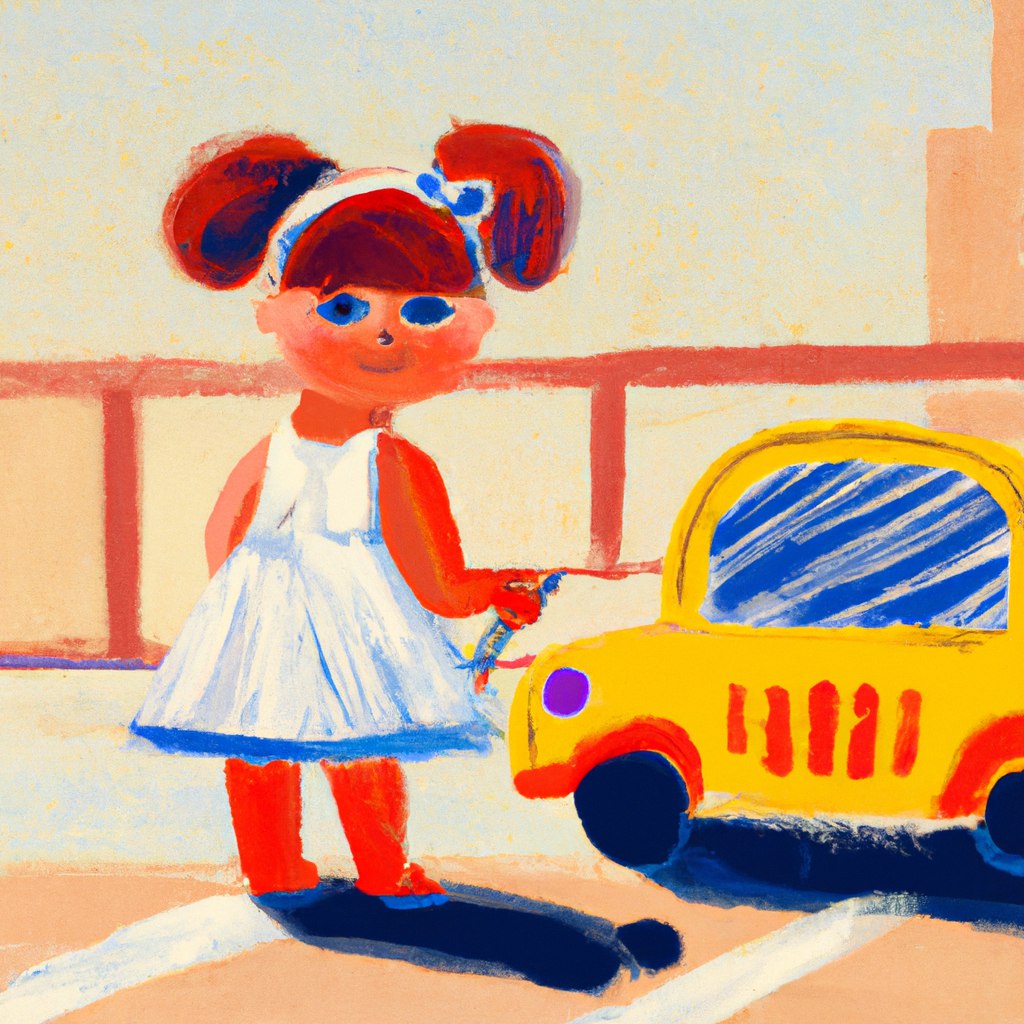
Nikki with her toy car
Her father hugged her and said, “You’re welcome, Nikki. You are very smart too. And now you know more about electricity than most people do.”




 Short stories for kids