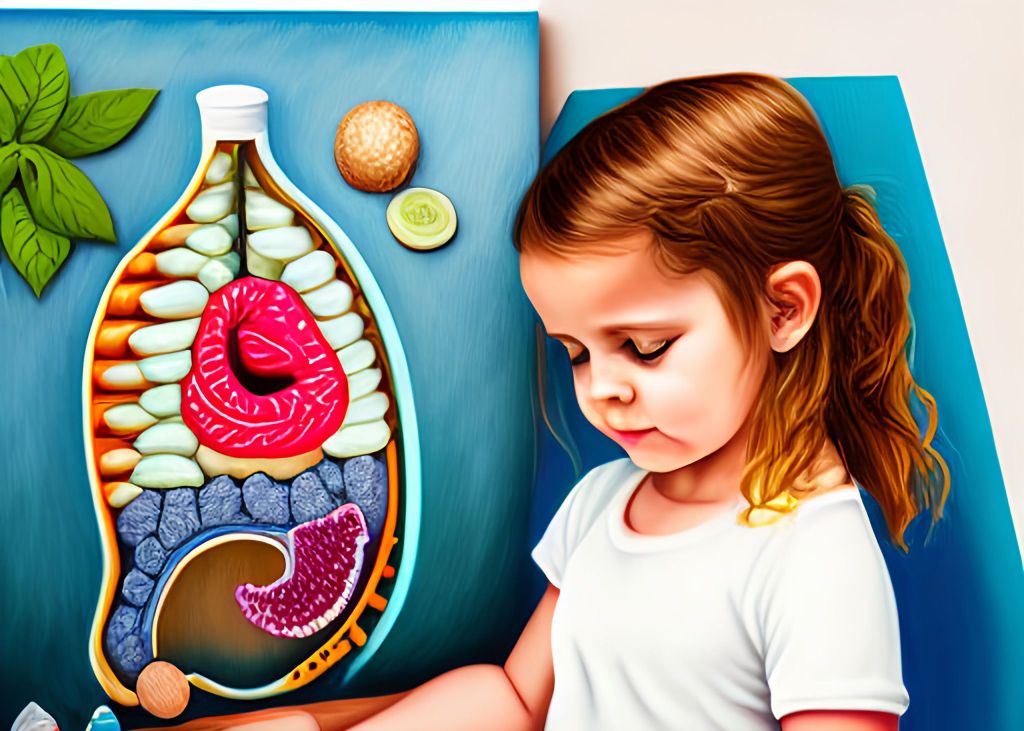
Once upon a time, there was a little girl named Nikki who loved to eat. She ate all kinds of food, like fruits, vegetables, bread, cheese, meat, and sweets. She enjoyed every bite and always asked for more.
But Nikki didn’t know what happened to the food after she swallowed it. She wondered where it went and how it made her grow and stay healthy. So one day, she asked her father: “Papa, what happens to the food I eat?”
Her father smiled and said: “Well, Nikki, the food you eat goes on a long and amazing journey inside your body. It travels through a special system called the digestive system. Do you want to hear about it?”
Nikki nodded eagerly and said: “Yes, please!”
Her father said: “Okay, then. Let’s start from the beginning. When you put food in your mouth, you chew it with your teeth. This helps to break down the food into smaller pieces. Then you use your tongue to push the food to the back of your mouth and swallow it. This is how the food enters your esophagus.”
“What’s an esophagus?” Nikki asked.
“An esophagus is a long tube that connects your mouth to your stomach. It squeezes the food down with waves of muscle contractions called peristalsis. It’s like a slide that carries the food to your stomach.” Her father explained.
“Wow, that sounds fun!” Nikki said.
Her father continued: “When the food reaches your stomach, it meets a strong acid called gastric juice. This acid helps to digest the food further and kill any germs that might be in it. Your stomach also churns and mixes the food with the acid, turning it into a thick liquid called chyme.”
“Chyme? That sounds gross!” Nikki said.
Her father laughed and said: “It may sound gross, but it’s very important for your body. The chyme then leaves your stomach and enters your small intestine.”
“What’s a small intestine?” Nikki asked.
“A small intestine is a long and narrow tube that coils around your belly. It’s about 20 feet long in adults, but much shorter in children. Your small intestine is where most of the digestion and absorption of nutrients happens. It has tiny finger-like projections called Villi that absorb the nutrients from the chyme and send them to your bloodstream.”
“Villi? That sounds cute!” Nikki said.
Her father nodded and said: “They are very cute and very smart. They know which nutrients your body needs and which ones it doesn’t. The ones that your body doesn’t need are passed on to your large intestine.”
“What’s a large intestine?” Nikki asked.
“A large intestine is a wider and shorter tube that follows your small intestine. It’s about 5 feet long in adults, but much shorter in children. Your large intestine is where water and minerals are absorbed from the chyme and where waste products are formed. The waste products are called feces or poop.”
“Poop? That sounds funny!” Nikki said.
Her father smiled and said: “It may sound funny, but it’s very important for your body too. The poop then moves to your rectum, which is the last part of your large intestine. It stores the poop until you feel the urge to go to the bathroom. Then you use your muscles to push the poop out of your anus, which is the opening at the end of your rectum.”
“Anus? That sounds weird!” Nikki said.
Her father chuckled and said: “It may sound weird, but it’s very important for your body as well. The anus helps you get rid of the waste that your body doesn’t need anymore.”
“So that’s what happens to the food I eat?” Nikki asked.
“Yes, that’s what happens to the food you eat.” Her father confirmed.
Nikki was amazed by what she learned. She thanked her father for telling her such a wonderful story. She realized that her digestive system was like a magical factory that turned food into energy and growth for her body.
She decided to take good care of her digestive system by eating healthy foods, drinking plenty of water, and going to the bathroom regularly.
She also decided to share her story with her friends at school, so they could learn about their digestive systems too.
And they all lived happily ever after.
 Short stories for kids