Once upon a time, there was a little girl named Nikki. She loved to visit her village farm. She enjoyed playing with the animals, picking fruits and vegetables, and exploring the fields and woods. One day, she noticed a big pile of dried corn stalks near the barn. She wondered what they were for.
“Papa, what are you going to do with these?” she asked, pointing at the pile.
“Oh, those are for the biomass power plant,” her father said. “They take them and burn them to make electricity.”
“Biomass power plant? What’s that?” Nikki asked.
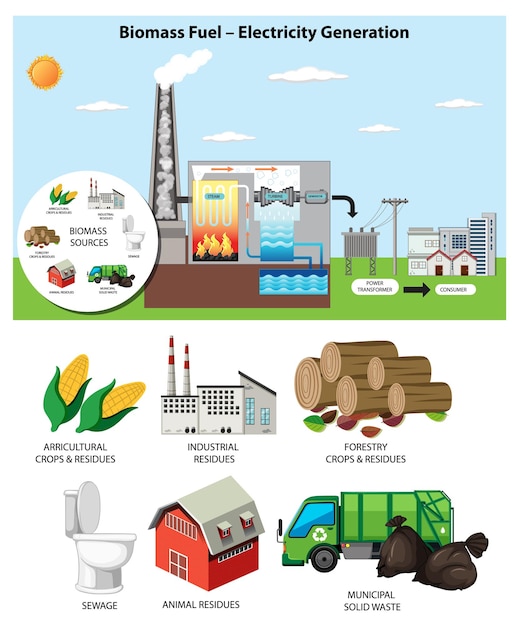
“Well, it’s a place where they use biomass to make energy. Biomass is anything that comes from living things, like plants and animals. They can use wood, crops, manure, and even garbage to make biomass energy.”
“Wow, that sounds cool. But how does it work?” Nikki asked.
Her father smiled and took her hand. “Come on, I’ll show you. They have a tour every week. Maybe we can catch it.”
They got in the truck and drove to the nearby town, where the biomass power plant was located. It was a large building with a tall chimney and a lot of pipes and wires. They parked and joined a group of people who were waiting for the tour guide.
“Welcome to the biomass power plant,” the guide said. “My name is Vidhi, and I’m going to show you how we make energy from biomass. Follow me, please.”
Vidhi led them inside the plant, where they saw a conveyor belt carrying loads of biomass to a big furnace. Nikki saw corn stalks, wood chips, and even some banana peels and egg shells.
“Where does all this come from?” Nikki asked.
“Well, some of it comes from farms, like your Village farm. They grow crops like corn and wheat, and they give us the parts that they don’t need, like the stalks and the husks. Some of it comes from forests, where they cut down trees for lumber and paper, and they give us the branches and the bark. And some of it comes from homes and businesses, where they separate their organic waste, like food scraps and yard trimmings, and they give us that too.”
“So you take all this stuff and burn it?” Nikki asked.
“That’s right. We burn it in the furnace, which heats up water in a boiler. The water turns into steam, which spins a turbine. The turbine is connected to a generator, which makes electricity. The electricity goes to the power lines, which deliver it to the homes and businesses in the area.”
Nikki looked at the power lines and saw the lights and signs in the town. She realized that they were powered by the biomass plant.
“That’s amazing. So you make energy from things that would otherwise be thrown away?” Nikki asked.
“Exactly. And by doing that, we also help the environment. Because if we didn’t use biomass, we would have to use more fossil fuels, like coal and oil. Fossil fuels are very old and take a long time to form. They also release a lot of carbon dioxide, which is a gas that makes the Earth warmer and causes problems like melting ice and rising seas. Biomass, on the other hand, is renewable and carbon neutral. That means we can grow more of it, and it doesn’t add any extra carbon dioxide to the atmosphere. It’s like a cycle: the plants take in carbon dioxide when they grow, and they release it when they burn. So it balances out.”
Nikki nodded. She understood that biomass was a good way of making energy. She was glad that her grandpa was part of it.
“Thank you for showing us, Vidhi. This is very interesting,” father said.
“You’re very welcome. I hope you enjoyed the tour. Do you have any questions?” Vidhi asked.
Nikki raised her hand. “I have one. Can I take some of these banana peels and egg shells home? I want to make a compost pile in my backyard. Maybe I can grow some plants and make my own biomass energy.”
Vidhi smiled. “That’s a great idea, Nikki. You’re a very smart and eco-friendly girl. Of course you can take some. Here, let me help you.”
Vidhi gave Nikki a bag and helped her fill it with some biomass. Nikki thanked her and hugged her father.
“Let’s go home, Papa. I want to start my compost pile. And maybe we can make some banana bread and scrambled eggs too.”
“Sure thing, Nikki. Let’s go. I’m proud of you, my little biomass engineer.”
They got in the truck and drove back to the farm, happy and hungry. Nikki looked at the bag and smiled. She had learned a lot about biomass production, and she was excited to try it herself. She knew that biomass was a good way of making energy, and she wanted to be part of it too.

 Short stories for kids